Sales dashboard software, sorted by who watches the screen.
Sales dashboard software pulls your sales numbers from the CRM and shows them as charts, leaderboards and goals that update on their own. It comes in five kinds, built for different people: managers at a desk, the whole company, coaches running contests, and the sales floor itself. GoalHorn is the last kind: a live sales dashboard for the office TV that celebrates every win.
GoalHorn is free for up to 5 reps. No account, nothing to install.
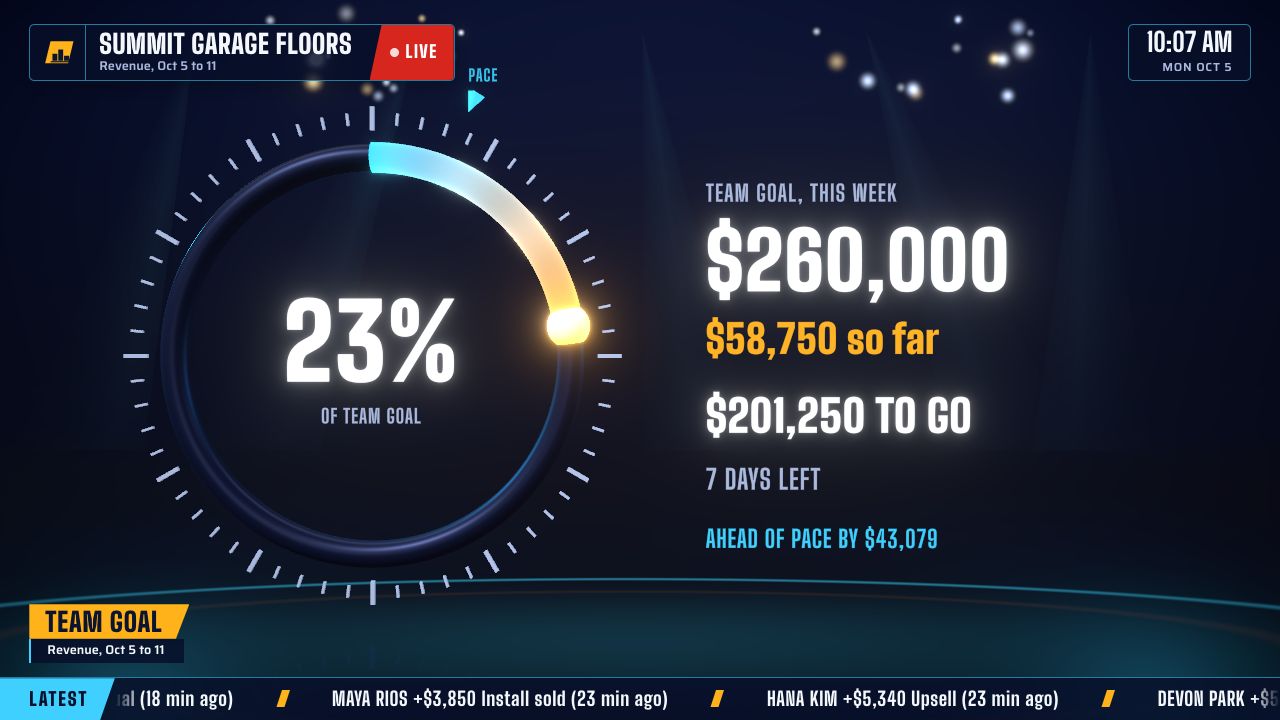
GoalHorn's team goal scene with a sample team. Pick another scene below the screen. Drawn live in your browser, no video.
The five kinds of sales dashboard software.
Start with who will look at the screen and where. The right kind follows from that, and many teams run two.
| Kind | Built for | Examples | Trade-off |
|---|---|---|---|
| BI and reporting | Managers and analysts digging into pipeline, forecasts and win rates. | Tableau, Power BI, Looker Studio | Deep, flexible and slow to set up. Built for a desk, not a wall. |
| CRM dashboards | Reports inside the CRM the team already uses. | Salesforce, HubSpot, Zoho CRM, HighLevel | Already paid for, but they need a login and are not made for a TV. |
| KPI and TV dashboards | Many teams' numbers on office screens, from many sources. | Geckoboard, Databox, Klipfolio | Strong charts for any department; on a sales floor they show numbers, not people. |
| Sales gamification | Contests, coaching, badges and commissions. | Spinify, SalesScreen, Plecto, Ambition | The most features, usually priced per user, often with onboarding. |
| Live sales TV dashboards | The sales floor: rank the reps, show the goal, celebrate every win. | GoalHorn | One job done well. No pipeline analytics or forecasting. |
Weighing a KPI dashboard tool for the sales floor? See GoalHorn vs Geckoboard. Running HighLevel? See the GoHighLevel sales dashboard setup. Weighing a gamification suite? Read what works in sales gamification.
Five dashboards a sales floor watches.
Shown as GoalHorn draws them, each answering one question in a glance. More in 12 sales dashboard examples.
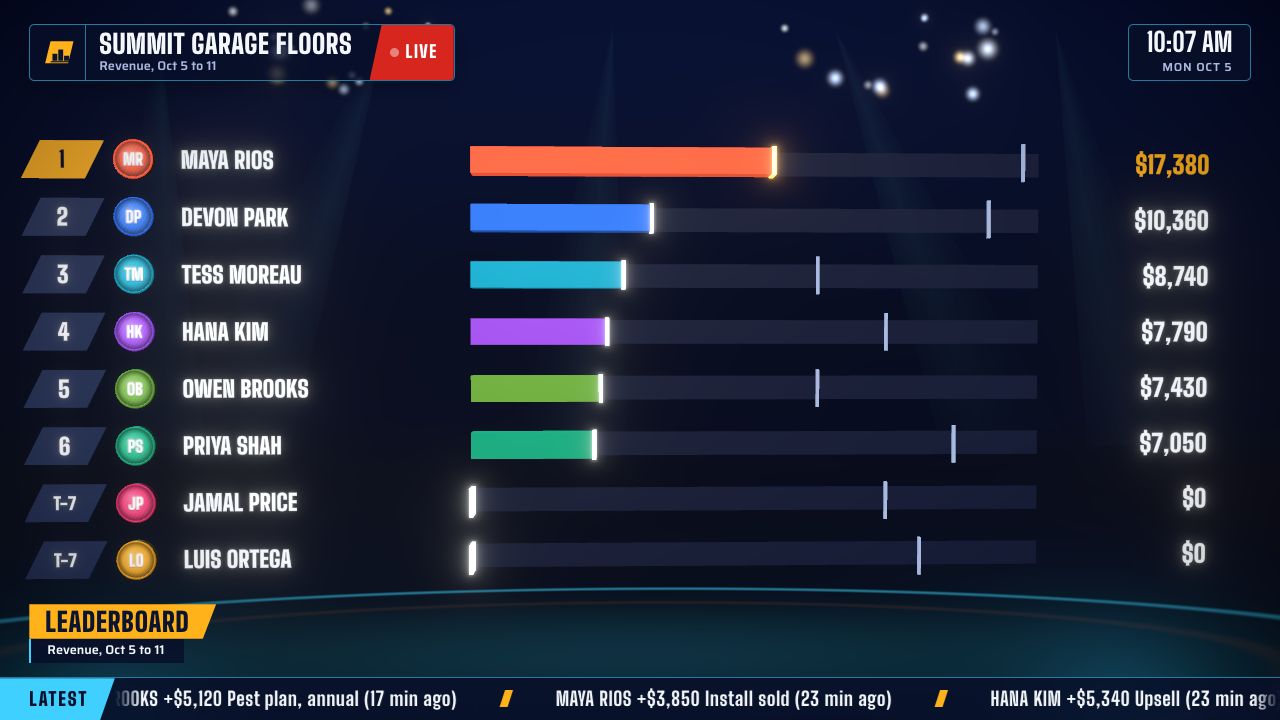 Who is winning
Sales leaderboard
Every rep ranked by revenue, with each rep's goal marked on the bar. The most-watched sales dashboard there is, because it is about people.
- Are we on track
Team goal and pace
Progress toward the month's target, what is left, the days left and whether the team is ahead of pace.
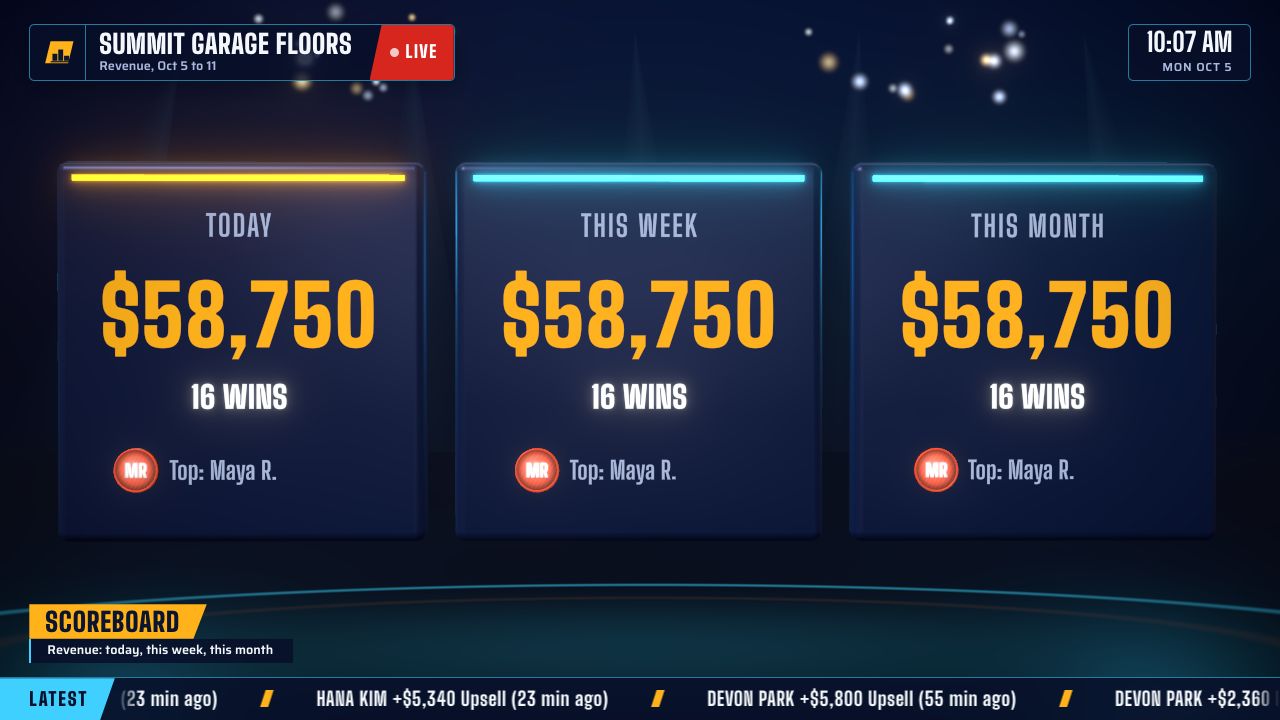 At a glance
Sales scoreboard
Today, this week and this month side by side, with the top rep in each. The sales KPI dashboard for a morning meeting.
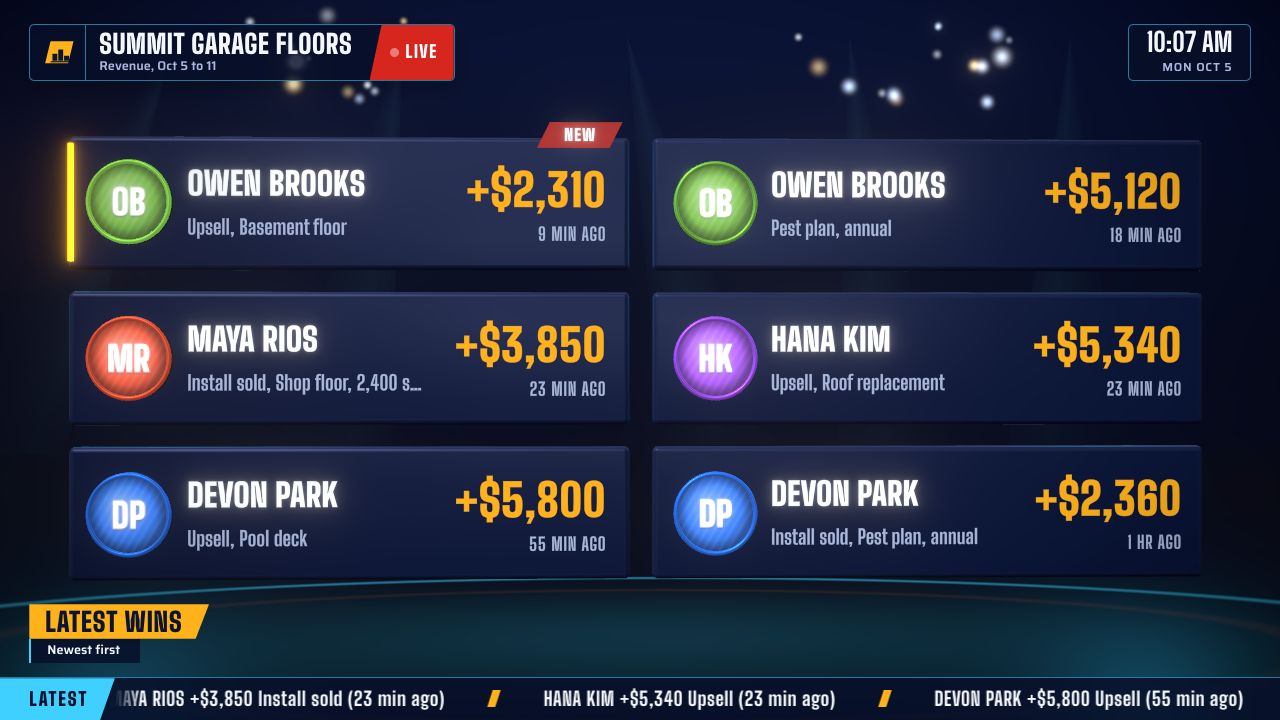 What just happened
Recent wins
The latest deals with the rep, the amount and what sold, newest first.
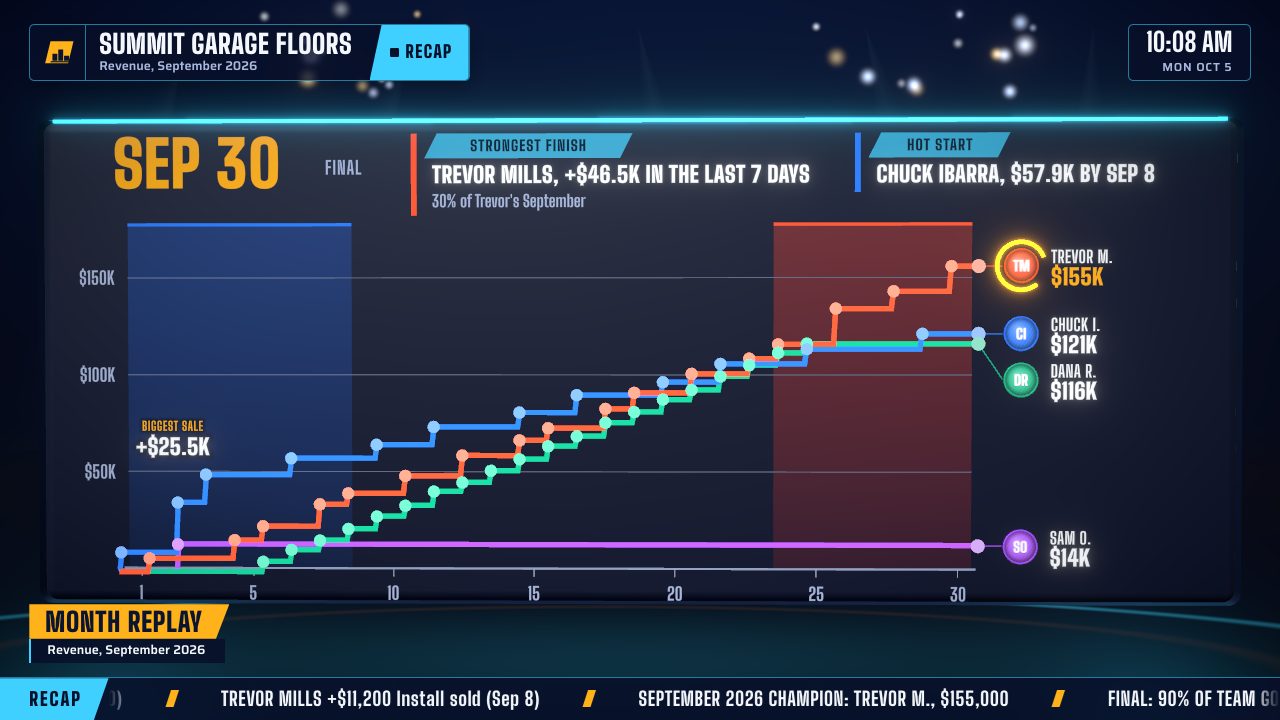 How the month went
Month replay
The month raced back day by day, ending on the strongest finish and the hot start. A sales performance dashboard you can watch.
Three more belong on a manager's screen rather than the wall, and BI or CRM tools draw them well: a pipeline dashboard (open deals by stage, value and age), a forecast dashboard (committed and best case against quota) and an activity dashboard (calls, emails and meetings by rep).
What a sales dashboard should include.
Fewer, bigger numbers. A screen with twenty charts gets read by nobody; a screen with five gets read by everyone.
The 5-second rule: someone glancing up should get the main message in about five seconds. On a sales TV, that is who is leading, how far the team is from the goal, and what just closed.
Revenue against goal, with pace
Not just the total: whether the team is ahead of or behind where it needs to be today.
A leaderboard by rep
Ranked by the number that pays, with a second number for context: deals, units or meetings.
Deals closed and average deal size
Volume and value together show whether a big month came from many deals or one.
One or two leading indicators
Meetings booked, appointments set or win rate: the work that predicts next month's revenue.
The latest wins
Who closed what, a few minutes ago. It is the reason people keep looking up at the screen.
How to choose sales dashboard software.
Six questions settle it faster than any feature list.
Who looks at it, and where?
Managers at a desk need drill-downs and filters. A sales floor needs a TV that reads from across the room.
Where does the data live?
Check that it reads your CRM, directly or through a Google Sheet that Zapier, Make or a CRM workflow fills.
How live is live?
Nightly refreshes are fine for reports. A sales floor wants a closed deal on the screen within a minute.
What happens to the price as you hire?
Per-user pricing grows with every rep; a flat price does not.
Does it run on the TV you already have?
Some tools need a player box or an app on every screen; others run in the TV's browser.
Who keeps it running?
A dashboard that needs an analyst to maintain it stops getting updated. Pick one the sales manager can change.
Where GoalHorn fits.
GoalHorn is the sales floor's screen. Keep your CRM's reports for managers and give the floor something to watch.
What it does
A live leaderboard, the team goal with pace, the latest wins, a scoreboard and the month replay, rotating on the office TV, with a full-screen celebration for every win.
What it reads
A Google Sheet that your CRM fills through Zapier, Make or a GoHighLevel workflow, checked every 30 seconds. Or, with no sheet, wins logged with + Win on the computer that runs the TV.
What it leaves to others
Pipeline analytics, forecasting and drill-downs. If that is the job, a BI tool or your CRM's dashboards do it better.
Setting up the screen? Read the sales TV dashboard guide or what makes a sales leaderboard work.
One flat price for the whole floor.
Not per rep and not per screen. Monthly, cancel any time.
Free
One board for up to 5 reps, with the podium, race and goal scenes and a celebration for every win.
Team, $49 a month
Every rep on the board, every scene including the Replay, every look and sound, and no GoalHorn mark.
Floor, $149 a month
Up to three boards for different teams or offices, your own celebration sound, and rotating between two numbers.
Want to run it with your own team first? Ask for a 14-day trial key.
Sales dashboard questions.
What is sales dashboard software?
Software that pulls sales numbers from your CRM or a spreadsheet and shows them as charts, leaderboards and goals that update on their own, so managers and reps can see performance without building reports.
What is the best sales dashboard software?
It depends on who watches the screen. For managers analyzing pipeline and forecasts, a BI tool or your CRM's dashboards. For the sales floor, a live TV dashboard like GoalHorn. For contests and coaching, a gamification suite. Many teams use two: one for reporting, one for the wall.
What should a sales dashboard include?
Revenue against the goal with pace, deals closed, a leaderboard by rep, and two or three leading indicators such as meetings booked or win rate. Fewer, bigger numbers beat a page of small charts.
Is KPI dashboard software the same as sales dashboard software?
KPI dashboard software is the wider category: it charts any team's metrics, from support to finance. Sales dashboard software focuses on revenue, deals and reps. A sales TV dashboard narrows it further to what a sales floor watches: the leaderboard, the goal and the latest wins.
What are the three main types of dashboards?
Operational dashboards show what is happening now, analytical dashboards explain trends, and strategic dashboards track goals over months. A sales TV dashboard is operational: it shows today's wins and the standings as they change.
What is the 5-second rule for dashboards?
Someone glancing at the dashboard should get its main message within about five seconds. On a sales TV that means the leader, the gap to the goal and the latest win, readable from across the room.
Is there free sales dashboard software?
Looker Studio is free for reporting, most CRMs include dashboards, and GoalHorn is free for one board with up to 5 reps, with a celebration for every win.
Can I put a sales dashboard on a TV?
Yes. Any dashboard that runs in a browser can go on a TV, but most are built for a desk. GoalHorn is built for the TV: big type, scenes that rotate on their own and a full-screen moment for every win.
Product names are trademarks of their owners and appear only as examples of each kind of software. Levology Labs is not affiliated with any of them.
Give the floor a dashboard it watches.
Free for up to five reps. $49 a month flat when the whole team is on it.
Want Team or Floor features first? Ask for a 14-day trial key.