Loan officer goals: units, volume and pace.
The average producing loan officer closes just under two loans a month, retail loan officers at benchmarked lenders closed 3.8 to 7.6, and the top 20% fund more than ten. A good monthly goal comes from your own pipeline instead: a number of funded loans, the volume they add up to, and the pace to get there by the last business day.
The calculator runs in this page. Nothing you type leaves it.
What the industry reports.
Closed loans per loan officer per month, as each source states it. Sources count differently (all production staff or only loan officers, averages or top producers), so read them as a range.
- All producing loan officersAverage, 21 loans a year (National Mortgage Professional, MMI data, October 1, 2024)
- Top 10% of producing loan officers53 loans a year (National Mortgage Professional, MMI data, October 1, 2024)
- Retail loan officers at benchmarked lendersYearly averages, 2018 (3.8) to 2020 (7.6) (MBA and STRATMOR, July 11, 2022)
- Scotsman Guide Top Originators entry bar75 loans in a year, or $25 million (Scotsman Guide, 2026)
- Top 20% of loan officersTypically fund more than ten a month (STRATMOR Group, January 10, 2023)
Sources, checked November 9, 2026: Recruiting By The Numbers (National Mortgage Professional, MMI data, October 1, 2024); MBA Chart of the Week: Retail Loan Officer Productivity (MBA and STRATMOR, July 11, 2022); How to Enter Top Originators (Scotsman Guide, 2026); Productivity: More Important Than Ever (STRATMOR Group, January 10, 2023). Each figure is as the source states it; the sources measure different things, so treat them as a range.
Set goals from the pipeline.
Funded loans are the result. Applications and pull-through are what a loan officer can move this week, so the goal should reach back to them.
Start from the branch target
Funded units and volume for the month, from the business plan or the same month last year.
Split it by what each loan officer funds
Weight each loan officer by their last three to six months, so a new LO and a top producer each get a goal they can reach.
Work back to applications
Divide each funded-loan goal by your pull-through rate. MBA's retail benchmark put application-to-closing pull-through at 69% for independent mortgage banks and 55% for depositories in the first half of 2025. At 69%, 6 fundings need about 9 applications.
Convert units to volume
Multiply by your average loan amount, or set the volume goal directly if your loan officers are paid on volume.
Check pace every business day
The goal is set once a month; the pace changes daily. Put both where the branch can see them.
Loan officer pace calculator.
Where a loan officer or the branch should be by today, where the month is tracking to finish, and what each business day left needs. The average loan amount starts at $448,500, the average purchase application in late October 2026 (MBA survey data, reported by NAHB); use your own.
The production report, live on the branch TV.
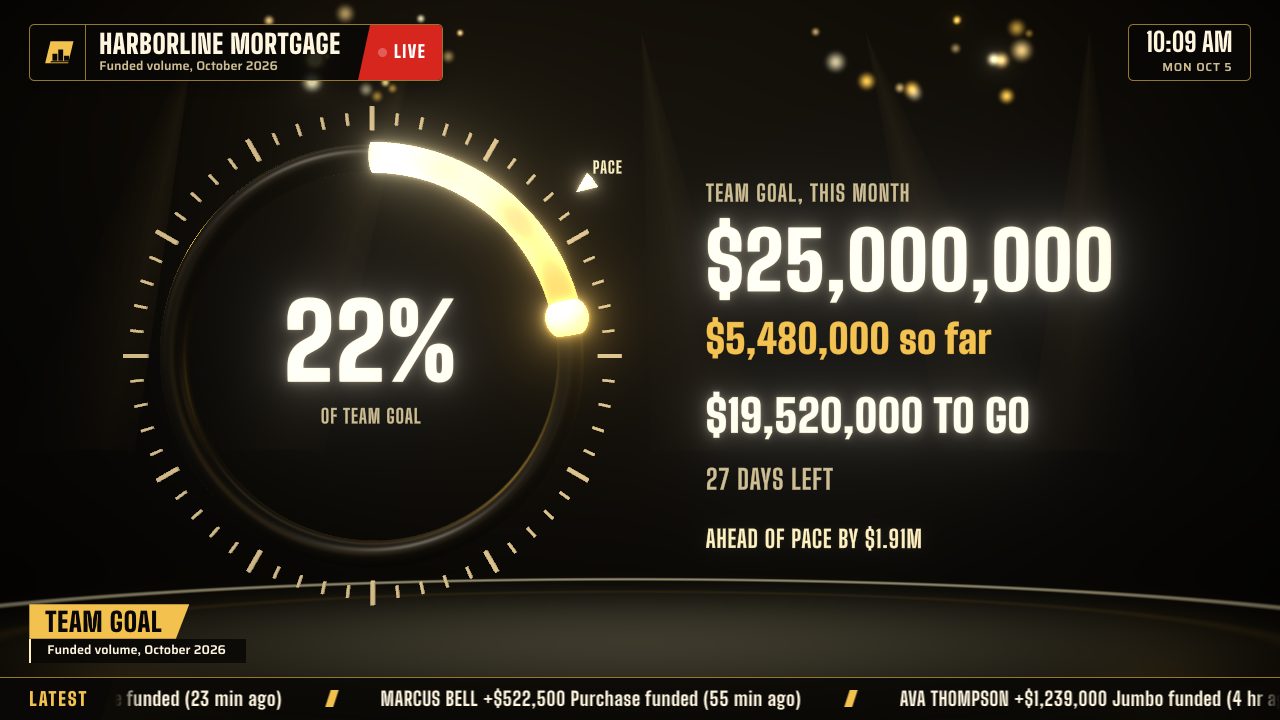
GoalHorn ranks your loan officers by funded volume with units beside it, fills the branch goal with pace, and rings the bell when a loan funds. It reads a Google Sheet, so no borrower data has to leave your systems.
Keep goals and prizes on permitted measures. Regulation Z bars paying a loan originator compensation based on a term of a transaction or a proxy for one (12 CFR 1026.36(d)(1)), and its official commentary counts awards of merchandise, services, trips or similar prizes as compensation.
The same commentary lists overall dollar volume, the number of transactions, the long-term performance of an originator's loans, the share of applications that close and the quality of loan files as factors that are not terms. Build goals, contests and prizes on those, and check anything else with your compliance team. This is not legal advice.
One flat price for the branch.
Not per loan officer. Monthly, cancel any time, and every screen in the office runs the same link.
Free
One board for up to 5 loan officers, with the podium, race and goal scenes and a celebration for every funding.
Team, $49 a month
Every loan officer in the branch, every scene, look and sound, and no GoalHorn mark on the TV.
Floor, $149 a month
Up to three boards (one per branch, or fundings and applications), your own celebration sound, and rotating between volume and units.
Want to run it with your own branch first? Start a free 14-day Team trial with a card, then $49/month unless you cancel.
Loan officer goal questions.
How many loans should a loan officer close a month?
Across all producing loan officers, MMI counted about 21 loans a year in 2024, just under two a month. Retail loan officers at lenders benchmarked by MBA and STRATMOR closed 3.8 to 7.6 a month from 2018 to 2021, and STRATMOR puts the top 20% above ten a month. Set the goal from your branch's own pipeline.
How do you set a loan officer's monthly goal?
Start from the branch's funded target, split it by each loan officer's last few months, then work back to applications: the goal in loans divided by your pull-through rate is the number of applications each one needs. At 69% pull-through, 6 fundings need about 9 applications.
What goes on a loan officer production report?
Funded units and funded volume by loan officer for the month, against each goal, often with applications, locks and pull-through beside them. The headline numbers belong on the branch TV; the detail stays in the LOS.
Can goals or contests pay more for certain loan types?
Not on the loan's terms. Regulation Z bars paying a loan originator based on a term of a transaction or a proxy for one, and prizes count as compensation. Overall dollar volume and the number of loans are listed as permitted factors, so build goals and prizes on those and check any contest with your compliance team first.
How do you calculate pace for the month?
Divide the loans funded so far by the business days done, then multiply by the business days in the month. 9 loans after 10 of 21 business days is tracking to about 19.
For the board itself, see the loan officer leaderboard, or how a digital sales board keeps score by industry.
Ring the bell for every funding.
Free for up to five loan officers. $49 a month flat for the whole branch.