How many cars should a salesperson sell a month?
About 10 to 12 units a month is typical. NADA's 2025 data works out to about 9.5 new vehicles a month per new-vehicle salesperson and 11.6 used per used-vehicle salesperson, and NADA's own guide is 12 to 15. The better number is your store's: set each goal from your history, then track pace every selling day so nobody finds out on the 28th.
Every figure below links to its source. The calculator runs in this page, and nothing you type leaves it.
What the trade reports.
Units per salesperson per month, as each source states it. Blue bars are what salespeople sold; amber bars are targets. The sources count different things (new or used, averages or goals, one year or decades), so read them as a range, not a rule.
- New vehicles per new-vehicle salespersonUS franchised dealer average: 114 in 2025, 102 to 114 a year since 2018 (NADA, 2026)
- Used vehicles per used-vehicle salespersonSame dealers: 139 in 2025, 137 to 148 a year since 2018 (NADA, 2026)
- Store averages at the dealers one consulting firm reviewedNew and used retail, 2019; average and median 11 (Woodward & Associates, November 2020)
- What most dealers say their store averages57% of more than 100 dealers; 22% said 5 to 9, 16% said 15 to 19 (Automotive News, February 3, 2025)
- A consultant's long-run averageFranchised dealerships since 1980, by Glenn Mercer's estimate (Automotive News, February 3, 2025)
- Roadster and NADA's 2020 study13 that spring and 16 in September, up from about 10 (Auto Remarketing, November 4, 2020)
- A consultant's suggested minimumOn a 60-day rolling average, after a salesperson's first 60 days (WardsAuto, August 28, 2018)
- NADA's guide for a salespersonNew and/or used department, a target (NADA, 2026)
Sources, checked November 10, 2026: NADA Data 2025 (NADA, 2026); Power Steering, November 2020 (Woodward & Associates, November 2020); Car dealer sales productivity 'stuck in a rut,' seeks AI fix (Automotive News, February 3, 2025); Study: Dealers continue to gain efficiency through digital retail (Auto Remarketing, November 4, 2020); Bane of Auto Dealerships: Low Productivity, High Turnover (WardsAuto, August 28, 2018); 2026 Formulas, Definitions and Guides (NADA, 2026). Each figure is as the source states it; the sources measure different things, so treat them as a range.
The Automotive News figures were read in the copy Impel republished. None of these organizations is affiliated with GoalHorn.
Why the answers conflict.
Ask five people and you hear 8, 10, 12, 15 and 20. Most of them are right about something: they are counting different things.
A fair reading: about 10 a month is average, 12 to 15 is a strong month and a sound goal, and a store that averages 15 or more is rare. In the Automotive News survey, 16% of dealers said theirs is 15 to 19.
An average is not a goal
NADA's data is what the average salesperson did: 9.5 new or 11.6 used a month in 2025. NADA's guide is what a sales department should aim for: 12 to 15. Articles quote one or the other and rarely say which.
New, used or both
NADA counts new-vehicle and used-vehicle salespeople separately. On a floor where everyone sells both, the closer comparisons are the dealer survey, where most stores said 10 to 14, and one consulting firm's review of 2019, where new and used together averaged 11.
Who counts as a salesperson
Count the new hires, the part-timers and the BDC and the average drops. Count only full-time floor salespeople and it rises. Settle your roster before you compare.
Which year
NADA's yearly figure has stayed between 102 and 114 new vehicles since 2018. A 2020 study by Roadster and NADA found 13 a month that spring and 16 in September, after about 10 for 35 years. By the January 2025 survey most dealers were back at 10 to 14, and one Michigan group told Automotive News its salespeople had gone from about 15 a month back to 10.
How a split deal counts
At half a unit each, the salespeople's numbers add up to the store's. Give both a full unit and every salesperson looks better than the store did.
How to set the store's unit goal.
The store's number comes first, because the salespeople's goals have to add up to it. The average franchised dealership sold 955 new vehicles in 2025, about 80 a month (NADA Data 2025), but your own history is the better guide.
Start from the same month last year
Car sales are seasonal, so compare with the same month a year ago, not with last month. Then adjust for how the last three months ran against the same three a year earlier.
Add what the store is paid on
The manufacturer's monthly objective and any volume bonus tier, for new and used together or apart. If a tier is within reach, the tier is the goal.
Check it against the lot
You can only deliver what you stock. NADA's guides are a 45-day supply of new vehicles, a 30-day supply of used and 1.25 used retail sales for every new one.
Check it against the floor
Divide the goal by your salespeople. 120 units across ten is 12 each, inside NADA's guide of 12 to 15. Across eight it is 15 each, the very top of it: add a salesperson or more leads, or lower the goal.
Check it against break-even
NADA's formula for the new-vehicle department: its total expenses, divided by the average gross profit per new vehicle retailed, is the number of units it takes to break even. The goal should clear that number.
Count the way the desk counts
Delivered units, a split deal at half a unit each, and unwinds taken back off. Put the rules in writing before the month starts, and put one number on the board.
How to set each salesperson's unit goal.
One number for everyone is easy, and it fits nobody: your top closer coasts and your newest hire gives up by the 10th. Set each goal from that salesperson's own record, then check that the goals add up.
To turn the goals into a game, see 20 car sales contest ideas: Beat your best sets every goal to a personal record, and the Rookie race keeps new hires out of the veterans' way.
Start from their last three months
Average them and add a unit or two. A goal a salesperson has never been near stops working as a goal.
Ramp the new hires
Give someone in their first 90 days a goal below the store's average that steps up each month, and race them against each other, not the veterans.
Make the goals add up
Add the individual goals together. They should reach the store's goal with a unit or two to spare, because someone will miss.
Keep the minimum separate
The minimum is what the pay plan requires; the goal is what the month aims for. One consultant, writing in WardsAuto, suggests a minimum of 12 units on a 60-day rolling average once a salesperson is past their first 60 days. Set yours against your own store's average.
Work back to the activity
Divide the goal by the closing rate. In a Foureyes study of about 700 US dealerships in the second half of 2023, 42% of shown appointments from new-vehicle internet leads ended in a sale; at that rate, 12 units take about 29 shown appointments. Use your own CRM's rate.
Turn the month into a daily number
12 units in a 30-day month is one every two and a half days, and six by the 15th. The calculator below works it out for any goal and any date, and the table after it has five common goals.
Car sales pace calculator.
Where the store or a salesperson should be by today, where the month is tracking to finish, and what each selling day left needs. Selling days, not calendar days, so a closed Sunday does not count against anyone.
The example is a store with a goal of 120 units that has delivered 52 after 12 of its 26 selling days: it is tracking to about 113.
Tracking
Units so far, divided by the selling days done, times the selling days in the month. The free car sales tracker template calls it Pace and works it out for every salesperson.
52 ÷ 12 × 26 = 112.7, about 113Ahead of or behind pace
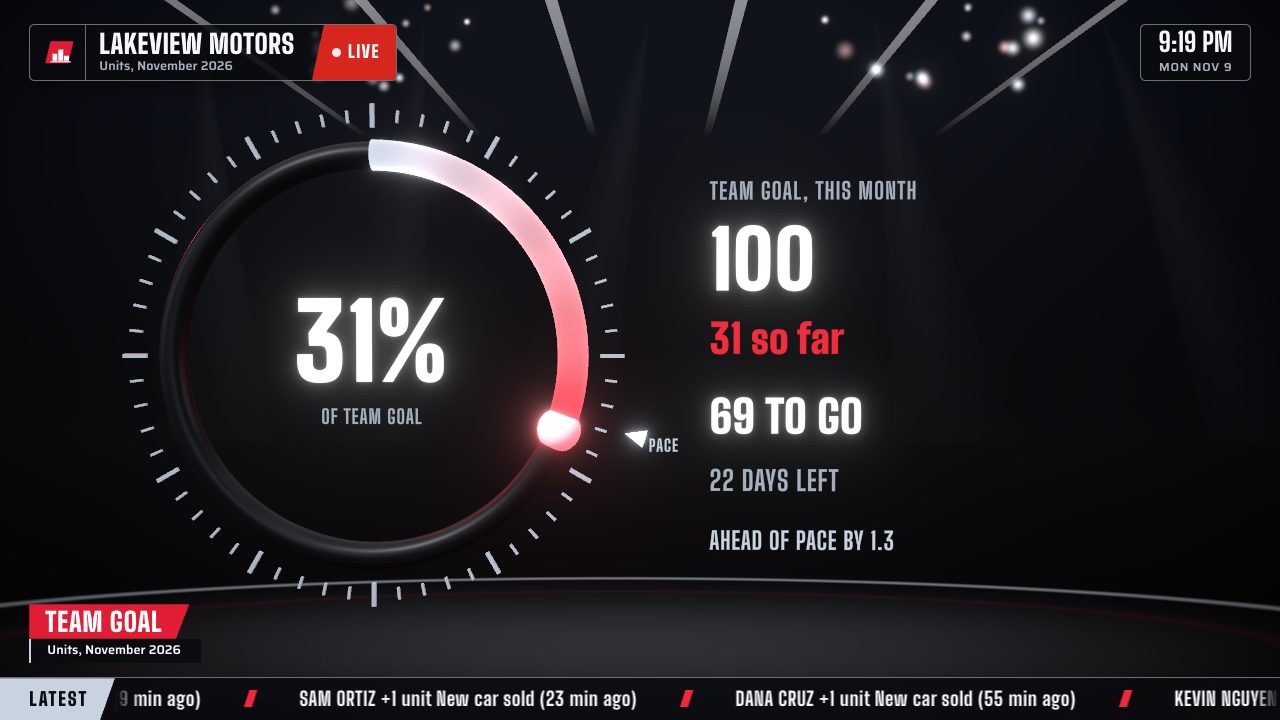
Units so far, minus where an even month would be today: the goal times the share of the selling days that are gone. The TV's goal ring shows the same gap.
52 minus (120 × 12 ÷ 26) = 3.4 behindNeeded a day
Units to go, divided by the selling days left. Compare it with the rate so far to see how much the floor has to pick up.
68 ÷ 14 = 4.9 a selling day, against 4.3 so far
Where a salesperson should be by the 10th, 15th and 20th.
An even pace through a 30-day month for five common goals. A salesperson under the number for today's date is behind pace. Half units are real: a split deal counts 0.5 for each salesperson.
| Monthly goal | One unit every | By the 10th | By the 15th | By the 20th | By the 25th |
|---|---|---|---|---|---|
| 8 units | 3.8 days | 2.7 | 4 | 5.3 | 6.7 |
| 10 units | 3 days | 3.3 | 5 | 6.7 | 8.3 |
| 12 units | 2.5 days | 4 | 6 | 8 | 10 |
| 15 units | 2 days | 5 | 7.5 | 10 | 12.5 |
| 20 units | 1.5 days | 6.7 | 10 | 13.3 | 16.7 |
The table counts calendar days. For your own month, with Sundays and holidays closed, use the calculator above with your selling days.
Put the goal and the pace on the TV.
A calculator answers the question once. GoalHorn answers it all month on the showroom or sales office TV, and updates it with every delivery.
The store's goal ring
Units to go, days left, and Ahead of pace by or Behind pace by: the calculator's gap, worked out by the clock so it moves through the day. The car dealership setup asks for the unit goal.
A goal on every bar
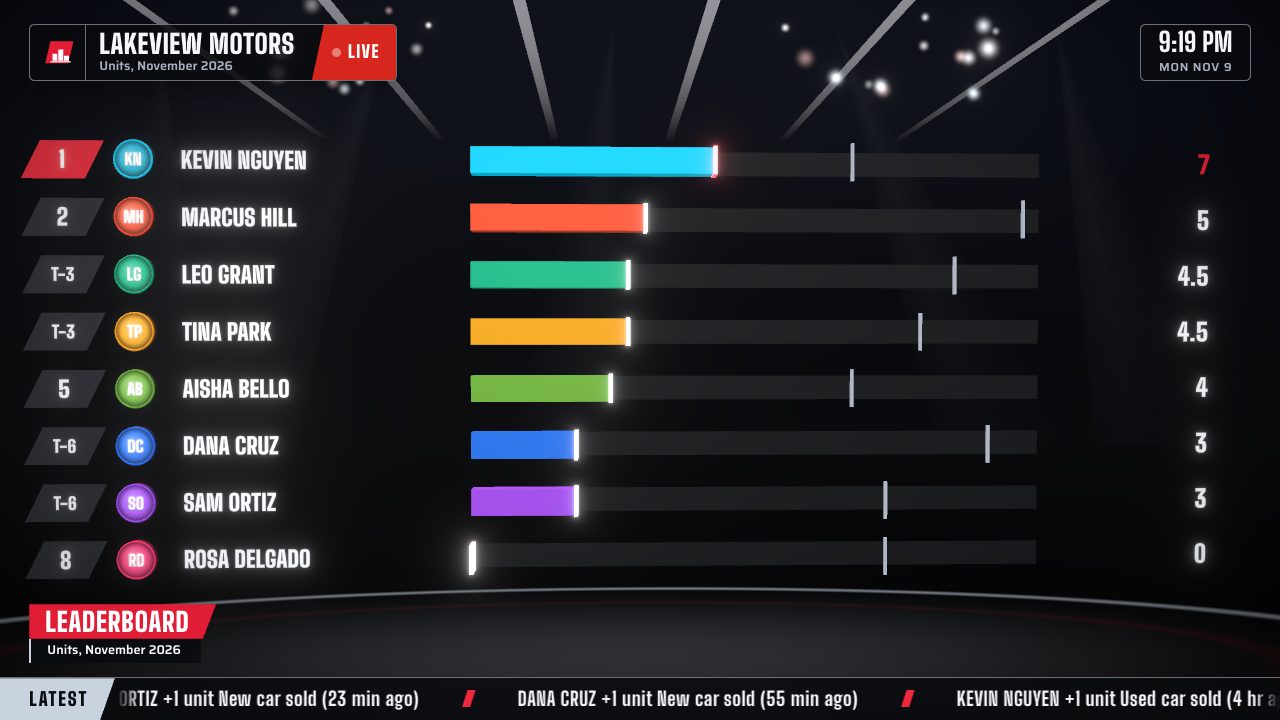
Type each salesperson's goal on the Reps page and it shows as a marker on their bar in the leaderboard race, so the floor sees who is close.
A bell for every delivery
Every unit celebrates on the TV as it is logged, by the desk or from a Google Sheet that GoalHorn reads every 30 seconds. Run a month-end push from 20 car sales contest ideas, and start the deal log from the free car sales tracker, which already works out pace.
One flat price for the whole store.
Not per salesperson and not per screen. Monthly, cancel any time.
Free
One board for up to 5 reps, with the podium, race and goal scenes, so the goal ring and the goal markers are included, and a celebration for every delivery.
Team, $49 a month
Every salesperson on the board, every scene including the Replay, every look and sound, and no GoalHorn mark.
Floor, $149 a month
Up to three boards (new, used and the sales office), each with its own goal, your own celebration sound, and rotating between units and gross.
Want to run it through a month-end first? Start a free 14-day Team trial with a card, then $49/month unless you cancel.
Car sales goal questions.
How many cars does the average car salesperson sell a month?
About 10 to 12. NADA's 2025 data works out to about 9.5 new vehicles a month per new-vehicle salesperson and 11.6 used per used-vehicle salesperson, and 57% of dealers in an Automotive News survey (January 2025) said their store averages 10 to 14 a month.
Is 10, 15 or 20 cars a month good?
Ten is about average. Fifteen is the top of NADA's guide of 12 to 15 a month. Twenty is far above it: in the Automotive News survey, only 16% of dealers said their store averages even 15 to 19. A salesperson above your own store's average is doing well, whatever the national number says.
How many cars does a dealership sell a month?
The average franchised new-car dealership sold 955 new vehicles in 2025, about 80 a month, according to NADA Data 2025. Stores vary a great deal, so your own same month last year is a better place to start a goal.
How do you calculate tracking in car sales?
Divide units delivered so far by the selling days done, then multiply by the selling days in the month. 52 units after 12 of 26 selling days is tracking to about 113. Count selling days, the days the store is open to sell, so a closed Sunday does not drag the number down.
Should the goal count new and used together?
Most stores set one unit goal per salesperson for total retail units and watch new and used separately for the store. On GoalHorn, every delivery shows New or Used, and the Floor plan can run a board for each with its own goal.
Should a car sales goal count units or gross?
Units for the goal everyone sees: every salesperson controls them and the desk already counts them. Track gross beside it. On GoalHorn, gross is an optional second number on each deal and the goal is in units.
How do you count a split deal toward a goal?
Half a unit for each salesperson, the way most desks count it, so the salespeople's numbers add up to the store's. In the calculator and on GoalHorn, 0.5 works anywhere a whole unit does.
What goal should a new salesperson have?
Start below the store's average and step it up each month as they learn the inventory and the process. A rookie race against other new hires keeps them on a board they can win.
Can GoalHorn show each salesperson's goal on the TV?
Yes. Type a goal for each salesperson on the Reps page and it shows as a marker on their bar in the leaderboard race. The store's goal gets its own ring, with units to go, days left and the gap to pace. Both are on the Free plan, for up to 5 salespeople.
For the board itself, see what goes on a car sales board, or how a digital sales board compares with a whiteboard. Shopping for the software? See dealership leaderboard software, compared.
Selling days are the days the dealership is open and available to make a sale, as Cox Automotive defines them. Benchmarks and their sources are listed under What the trade reports, checked November 10, 2026.
Make the pace the floor's business.
Free for up to five salespeople. $49 a month flat for the whole store.